Wuling-Shizhu Terradraconidae
The Wuling-Shizhu corpus covers a Terradraconidae lineage distributed along the Wuling uplift in eastern Chongqing Municipality, from Shizhu Tujia Autonomous County in the south through the Wushan-Daning river corridor to a single far-northern outlier beyond the Yangtze gorges. Thirty-two specimens are inferred across the corridor: fourteen in the Shizhu core cluster, seventeen in the Wushan-Daning secondary cluster, and one outlier at Dragon Needle (龙针). Site-specific entries under archive/sites/ will handle per-specimen field data as placements are cleared for inclusion; this lineage entry summarises the clade-level description.
On the available evidence the population is assigned to family Terradraconidae, Lapidine (fold-thrust-belt) ecotype, with the proposed binomial Terradraco wulingensis sp. nov. — the Wuling mountain burrower. Clade-diagnostic criteria MC-1 through MC-5 and BC-1 and BC-6 are satisfied by the converged Tujia, Ba, Han, and MSS record. Source material for the description is fourfold: Tujia oral tradition (Baishou dance sequences, Timahge oral poetry, funerary texts, Nuo opera dragon masks), Ba 巴 precursor bronzes from Fuling, Han classical references (the Shan Hai Jing "Classic of Southern Mountains," Ge Hong's Baopuzi, and Qing-period Shizhu county gazetteers), and MSS instrumented survey data from nine astro ponds in the primary cluster (2004–2021).
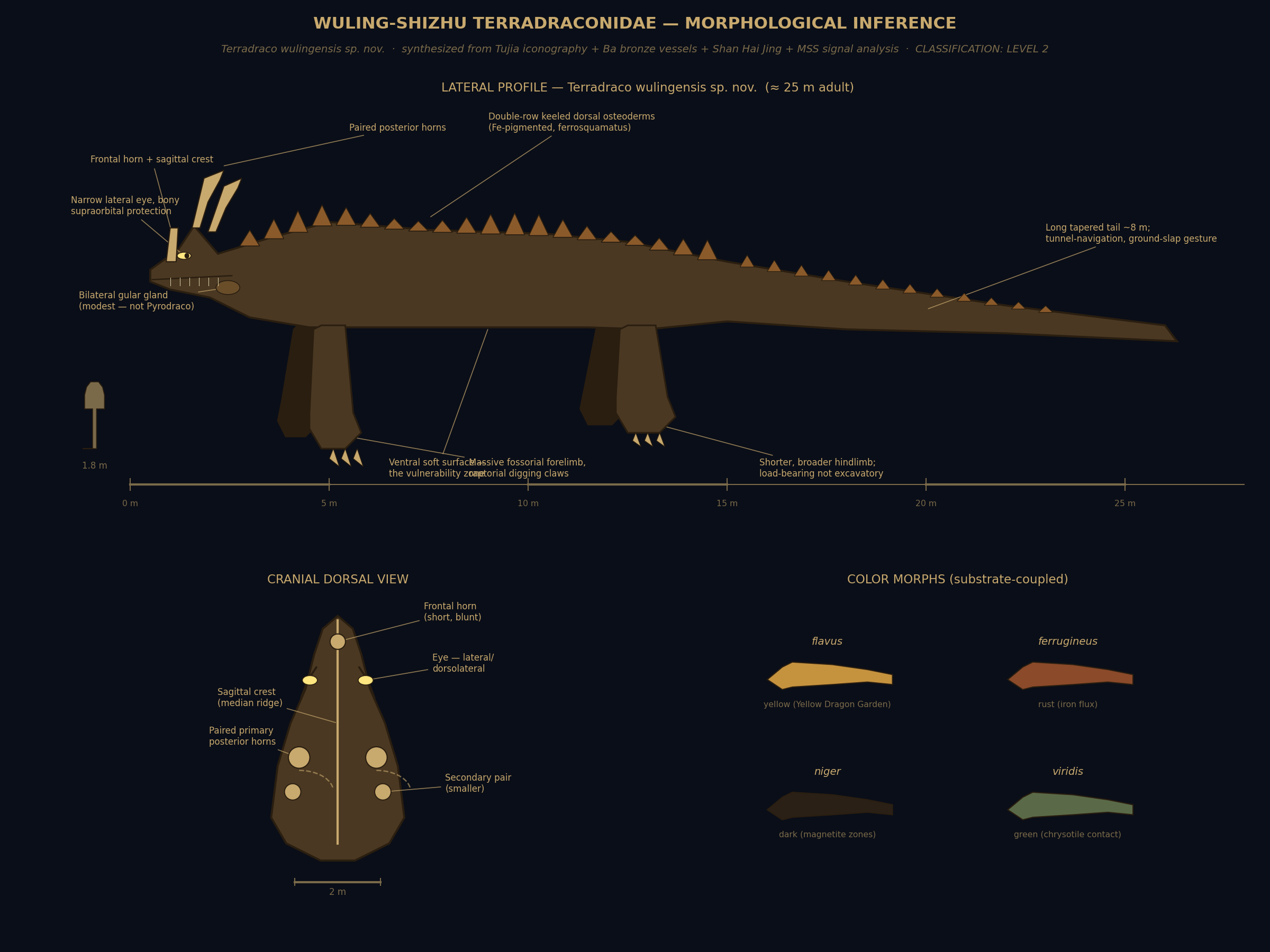
Morphologically the form is a heavily armoured ground-bound quadruped, not a celestial coiling ribbon. Adult length is 22–28 m, resolved into an elongate serpentine trunk of roughly 14 m, a heavy-muscled quadrupedal anterior of roughly 4 m, and a powerful tapering tail of roughly 8 m. Integument is a double dorsal row of large keeled osteoderms with ferrous pigmentation, flanked by smaller keeled scales and a softer ventral surface. The cranium carries two posterior horns, a blunter frontal horn, a low sagittal crest, lateral narrow eyes under bony supraorbitals, and a massive jaw. Forelimbs are short and stocky, terminating in five-digit raptorial fossorial claws; hindlimbs are shorter still and load-bearing rather than excavatory. The silhouette is closer to a massively armoured crocodilian with an over-long tail than to any aerial or ribbon-like form. A composite morphological diagram is provided at fig-wuling-dragon-morphology.png.
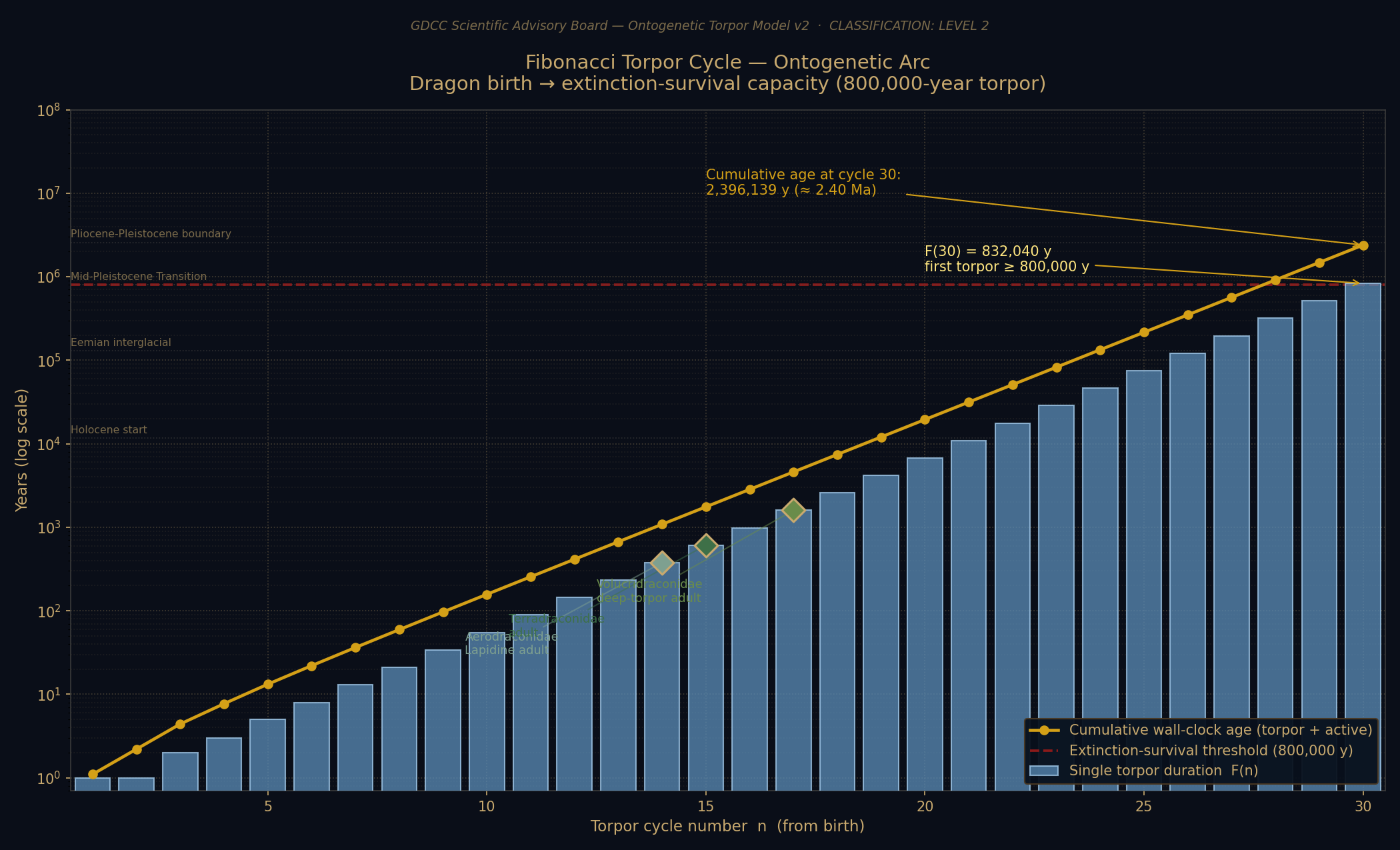
The most distinctive Wuling feature is colonial aggregation. The Eight Dragon Village (八龙村) site in the Shizhu core and the Nine Dragons (九龙) site in the Wushan-Daning secondary cluster carry coordinated groups of eight and nine specimens respectively — the largest documented coordinated Terradraconidae aggregations in the GDCC record. The field interpretation is a serpentinite-bound colonial nexus in which the cluster centres share a continuous chrysotile fibre mat, enabling signal coupling at depth. Thirty-two specimens are catalogued across three clusters; site-specific entries will be scribed under archive/sites/ as they are cleared for inclusion. Fibonacci torpor assignments place the Wuling population across cycles 15–25 (Adult–Mature), with the core Adult-class cycle 15–16 periodicity of 610–987 years aligning to the 600–800 year tremor cadence preserved in the Shizhu gazetteers; the cycle chart is at fig-fibonacci-torpor-lifecycle.png. Deeper site-level analysis of individual specimens is planned for future site entries under archive/sites/.
Claims
c0001 — Thirty-two specimens across three Wuling-Shizhu clusters
Instrumented survey and cross-referenced placename audit return thirty-two specimens inferred across the Wuling-Shizhu corridor. Fourteen specimens are concentrated in the Shizhu core cluster centred on Eight Dragon Village, with outlying satellites at Dragon Vat, Dragon Gate, Yellow Dragon Garden, two Dragon Temple sites, and Dragon Bridge Alley. Seventeen specimens are concentrated in the Wushan-Daning secondary cluster centred on Nine Dragons, with satellites at Two Dragons Waterfall, Coiled-up Dragon, Dragon Sky, Dragon Abyss, Dragon Gate Town, Dragon Gate North, and Dragon Town. One far-northern outlier is recorded at Dragon Needle.
c0002 — Tujia source-material corpus distinct from Han celestial iconography
The Tujia source-material corpus bearing on the Wuling lineage comprises the Baishou dance repertoire (coiled-serpentine body movement, ground-slapping rhythms, earth-listening postures), the Timahge oral poetry recited by Tima shamans (with the "breath that lifts the earth-skin" and "eight sleepers under the white-bark forest" passages), the Tujia funerary texts that route descent away from named ridges, and the Wuling variant of the Nuo opera dragon mask (low-profile, heavy-jawed, multi-horned, narrow sidelong eyes). The corpus is structurally distinct from Han celestial-dragon iconography and sits underneath the more visible Baihu white-tiger totemic stratum.
c0003 — Ba precursor bronzes depict quadrupedal fossorial form
Ba 巴 precursor material recovered from pre-Qin bronze vessels at Fuling depicts a quadrupedal fossorial creature rather than a celestial coiling serpent. The character 巴 originally depicted a large serpent, but the Ba iconographic record proper shows heavy limbs, broad jaws, and ground-bound posture. The Han-period regional record then shows progressive stylisation toward the unified celestial dragon icon, abstracting the Wuling-specific quadrupedal detail out of later material. The Ba-to-Han transition functions as an iconographic gradient from direct biological witness to court abstraction.
c0004 — Han classical references consistent with surface-signal activity
Han classical references converge with the MSS signal record. The Shan Hai Jing "Classic of Southern Mountains" describes quadrupedal, armoured, subterranean creatures (yingzhao 应詔 and zhulong 烛龙) in regions plausibly corresponding to the Wuling range. Ge Hong's Baopuzi (c. 320 CE) mentions dragon caves in "the mountains of Bashu" whose occupants are "neither winged nor swimming," explicitly distinguishing the Wuling form from coastal and aerial types. Qing-period Shizhu county gazetteers record periodic "earth tremors without breakage" and "warmth under the snow" at ridge locations that correspond to contemporary earth-pimple sites.
c0005 — Proposed binomial Terradraco wulingensis sp. nov.
The Wuling-Shizhu population is proposed as Terradraco wulingensis sp. nov., assigned to family Terradraconidae, Lapidine (fold-thrust-belt) ecotype. Clade-diagnostic criteria MC-1 (body mass macro-class), MC-2 (functional quadruped limb configuration), MC-3 (heavy keeled integument), MC-4 (multi-horn cranial crest), and MC-5 (raptorial fossorial ungual morphology) are satisfied. Behavioural criteria BC-1 (absolute habitat fixity) and BC-6 (multi-generational emergence cycle consistent with the Terradraconidae Fibonacci cadence) are likewise satisfied. The Lapidine assignment reflects extreme site-fidelity expression, unusual outside deep-time fossil forms.
c0006 — Body plan: armoured quadrupedal ground form, 22–28 m
Adult Wuling specimens are 22–28 m in total length, resolved into an elongate serpentine trunk of roughly 14 m, a heavy-muscled anterior quadrupedal segment of roughly 4 m, and a powerful tapering tail of roughly 8 m. The posture is low-slung with belly ground-contact at rest and anterior elevation on disturbance. The overall silhouette is a heavy, armoured, ground-bound animal closer to a massively armoured crocodilian with a disproportionately long tail than to any aerial or celestial form. The form matches Nuo mask heaviness and Ba bronze vessel proportions and is geometrically consistent with the site-fixed Lapidine ecotype.
c0007 — Integument colour-morph variation reflects torpor-site mineralisation
Four integument colour morphs are documented or inferred across the lineage: flavus (yellow) at goethite-hematite alteration zones such as Yellow Dragon Garden, niger (dark) at magnetite-rich basement zones, ferrugineus (rust) at active fault-zone iron flux sites, and viridis (green, inferred) at direct chrysotile contact. The empirical observation is that the morphs exist; the interpretive component is that they reflect the mineralisation environment of the individual specimen's torpor site rather than genetic variation, with the hypothesis that a given specimen takes on the colour of its embedment substrate over multi-millennial torpor duration and re-differentiates after re-descent.
c0008 — Eight Dragon Village and Nine Dragons are the largest coordinated Terradraconidae aggregations on record
The eight-specimen aggregation at Eight Dragon Village (八龙村) in the Shizhu core and the nine-specimen aggregation at Nine Dragons (九龙) in the Wushan-Daning secondary cluster are the largest documented coordinated Terradraconidae groups in the GDCC record. Of the three candidate interpretations (single-lineage family group, multi-specimen breeding assembly, or serpentinite-bound colonial nexus), the colonial-nexus interpretation is the most consistent with the HLSF chrysotile signal-coupling model: both cluster centres sit on continuous chrysotile mats, and the paired aggregation size argues against a dispersed-torpor breeding assembly alone.
c0009 — Fibonacci cycle 15–16 periodicity matches gazetteer tremor cadence
The Wuling lineage falls across Fibonacci torpor cycles 15–25 (Adult through Mature). The Adult-class cycle 15–16 canonical periodicity of 610–987 years aligns with the 600–800 year "earth tremors without breakage" cadence preserved in Qing-period Shizhu county gazetteers, and MSS signal amplitude analysis resolves the active fraction of the cluster to the same cycle band. None of the surveyed Wuling specimens have yet reached the cycle 30+ extinction-class capacity. The bracketing is the primary temporal argument for treating the gazetteer record as biological witness rather than seismic folklore.
c0010 — Cohort A entered active phase circa 2004 CE per the revised forecast doctrines
The 2004–2021 MSS instrumentation record documents progressive signal intensification across the primary cluster which, under the framework's active-phase architecture and the four-of-five indicator class convergence documented at doctrine-state-ideological-output-indicator-class c0009, is the diagnostic signature of cycle-15 active-phase onset rather than pre-emergence approach. Anchoring to 2004 (MSS instrumentation activation as operational onset marker), Cohort A is approximately 22 years into a ~102-year calendar-active interval, ending circa 2106 CE. The prior framing ("final 50–200 year window before a partial surface-active transition") is retired per the 2026-04-25 forecast-doctrine consistency audit; that framing inherited the same conservative-mode bias documented at doctrine-base-rate-active-phase-distribution c0004. The 2018–2021 Construction Hub expansion in the Shizhu county perimeter is consistent with active-phase institutional response, not preparation for a future event. The Construction Hub class is now operationalised at doctrine-active-phase-suppression-program, with the first GIS-pinned candidate installation at site-wushan-daning-construction-hub (30°46'17.99"N 109°22'19.52"E, Wushan-Daning secondary cluster envelope). The Shizhu-perimeter sister installations referenced in this claim remain to be coordinate-pinned (RG-APSP-05, RG-WDCH-06). Confirmation through retroactive pulse-cluster signature recovery from 2004–2026 MSS logs (per doctrine-next-emergence-ranking c0012) is the highest-priority forward task; the downstream karst-hydrology water-chemistry test at site-wushan-daning-construction-hub c0007 (a) is the highest-priority test of the suppression-program reading.
Canon-hygiene note (2026-04-25, evening update): the audit retired the conservative-mode bias at the doctrine-entry level but the propagation to KML resources requires explicit attention — the framework's KML files are at risk of carrying stale framings that get retired in doctrine entries. Specifically, Taishan_Convergence_Mating_Event.kml carried a c. 2130–2380 CE convergence projection inherited from the pre-revision conservative-mode framing; the KML was propagated with the audit on 2026-04-25 (corrected projection: convergence event within cycle-15 calendar-active interval 2004–2106 CE, central-estimate ~2055 CE, see encounter-yelang-dian-cycle18-containment-campaign c0013). Future audits at the doctrine level should include a cross-resource propagation check across resources/maps/*.kml, resources/figures/*, and any other framework-canonical resource files that may carry frozen projections from the doctrine state at scribe-date. The Taishan KML propagation is the canonical example; comparable propagation may be required at other multi-cycle projection KMLs and figures as the framework's cycle-15 active-phase reading continues to evolve.
c0011 — The 32 specimens are a youngest-tier assemblage above a deeper substrate lineage
Within the Founder-Lineage Depth model the thirty-two documented Wuling-Shizhu specimens constitute the youngest-tier lamina of the pod. The founder and any mid-tier generations lie beneath the mapped cluster at depths and phase durations outside the detection stack's current range. All published Wuling specimens are therefore descendants at a single generational horizon rather than a cross-section through the full pod. The gazetteer-attested tremor record, the astro-pond detection stack, and the active-phase-onset reading at c0010 (revised 2026-04-25) all describe the youngest tier only; the deeper lineage continues to cycle on its own schedule independent of the surface monitoring program.
c0012 — The 32 specimens resolve to five cohorts tied to specific historical mating events
Applying the Specimen Depth-Chronology Framework to the 32-specimen census resolves the Wuling youngest tier into five cohorts, each traceable to a prior mating event in a specific historical window:
- Cohort A — Adult class: 4 specimens at cycles 15-16, age approximately 1,596-2,583 years, depth approximately 50-200 m. Implied mating event ~557 BCE to 430 CE. Correlates with Warring States through Eastern Han dragon iconography elaboration in Chinese cultural production. This is the imminent-emergence cohort.
- Cohort B — Mid Adult class: 5 specimens at cycles 17-18, age 4,180-6,764 years, depth 200-500 m. Implied mating event ~4738 BCE to 2154 BCE. Correlates with the Neolithic-to-early-Bronze transition and earliest Chinese dragon iconographic attestation at Hongshan and related cultures.
- Cohort C — Elder Adult class: 6 specimens at cycles 19-20, age 10,945-17,710 years, depth 500-900 m. Implied mating event ~15684 BCE to 8919 BCE. Correlates with Upper Paleolithic cave-ritual transition into the early Holocene.
- Cohort D — Mature class: 7 specimens at cycles 21-22, age 28,656-46,367 years, depth 900-1,400 m. Implied mating event ~44341 BCE to 26630 BCE. Correlates with Late Pleistocene Phase Three ritual relationship formation documented in Chapter 4.
- Cohort E — Deep Mature class: 10 specimens at cycles 23-25, age 75,024-196,417 years, depth 1,400-2,000 m. Implied mating event ~194391 BCE to 72998 BCE. Correlates with Middle-to-Late Pleistocene hominin cave habitation across the broader encounter window.
The distribution is monotonically increasing in cohort size with depth, consistent with the generational contraction model's prediction that older cohorts retain more survivors. Cohort A's small size (4 specimens) is consistent with the model's expectation that the most recent cohort is the smallest.
c0013 — Cohort A is the primary subject of the current active-phase window assessment
The active-phase onset reading documented at c0010 (revised) applies specifically to Cohort A: the four specimens at cycles 15-16 currently at 50-200 m depth. The progressive signal intensification 2004-2021 is the summed output of this four-specimen cohort transitioning into and operating in parallel during the calendar-active interval rather than any single specimen in isolation. Which of the four has produced or will produce the most observable surface pulse-cluster events is the archive's finest-resolution open question at Wuling; differentiation among them requires per-specimen seismic localization that is not currently resolved by the detection stack. The retroactive pulse-cluster recovery protocol at doctrine-next-emergence-ranking c0012 is the operational mechanism for resolving the per-specimen attribution.